Reading time : 6 mins
Picture Wanjiru. She sells handmade bags from a small studio in Kilimani, mostly through Instagram. Business is good, but she's tired of the DMs. "Price?" "Do you deliver to Rongai?" "Let me send the money tomorrow." She wants a real online store.
So she Googles it, and Shopify is everywhere. Then a friend who sells skincare mentions SilkCommerce. Now she's stuck.
If you're in the same spot, this SilkCommerce vs Shopify breakdown is for you. We'll be honest: Shopify is a good product. It just wasn't built with a Kenyan seller in mind. We were.
First, credit where it's due
Shopify is one of the biggest store builders in the world. It has a huge collection of themes and apps, and plenty of famous global brands run on it.
If most of your customers are in London or Atlanta and they pay by card, Shopify makes a lot of sense. We'd probably tell you to use it.
But if your customers are in Kasarani, Nakuru and Kisumu, and they pay from their phones, the picture changes fast.
Getting paid: the M-Pesa question
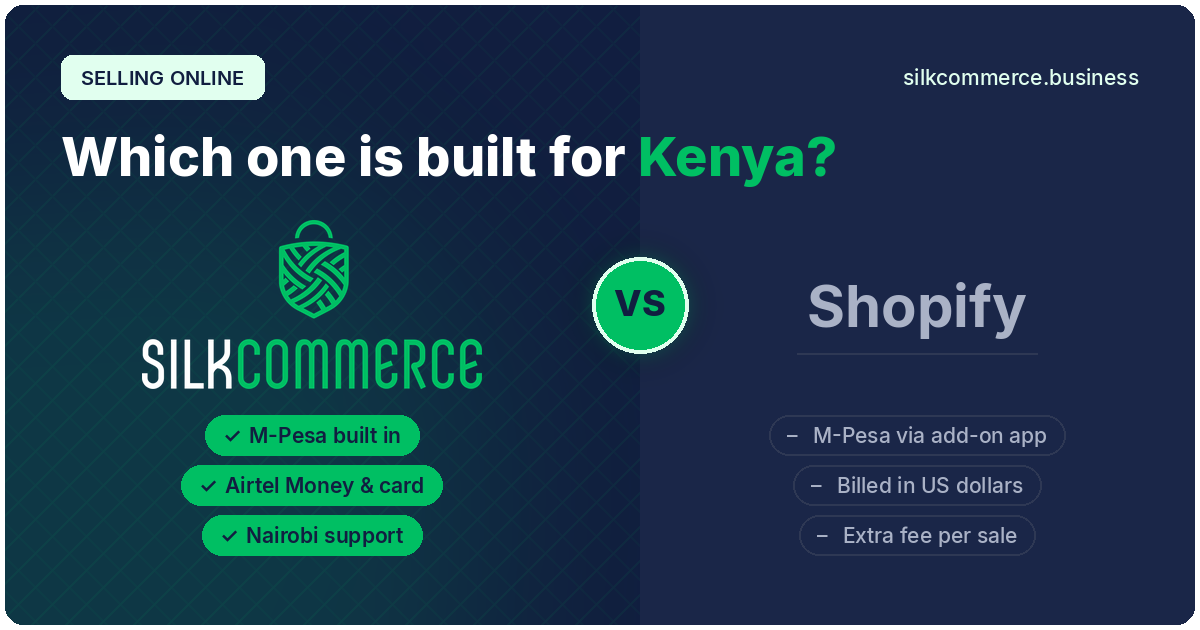
Here's the thing most sellers only find out after signing up. M-Pesa isn't one of Shopify's built-in payment options.
To take M-Pesa on Shopify, you have to go and find a payment app from another company, open an account with them, get approved, and connect it to your store. It works, but now you're dealing with two companies instead of one. When a payment goes missing on a Friday night, who do you call?
On SilkCommerce, getting paid is part of the store from the very first day. Your customer reaches checkout and pays with M-Pesa, Airtel Money or card. No plugins to hunt for, no screenshots to check, no "nimetuma" messages you have to verify by hand.
Let's talk money (in shillings)
This is where the difference really shows.
Shopify charges in US dollars. At the time of writing, its Basic plan is USD 39 a month, or USD 29 a month if you pay for a whole year upfront. That's somewhere around KES 3,700 to 5,000 a month, and it moves every time the shilling does.
Then, because you're using an outside payment app for M-Pesa, Shopify adds its own 2% fee on every sale. That's on top of whatever the M-Pesa app provider charges you, which is often around 1.5%.
SilkCommerce plans cost KES 500 to KES 3,000 a month, priced in shillings. There's a 1% fee on payments made through your store, and that's it.
Let's put real numbers on it. Say Wanjiru sells KES 200,000 worth of bags in a month:
| Shopify (Basic, monthly) | SilkCommerce | |
|---|---|---|
| Plan | About KES 5,000 | KES 500 to 3,000 |
| Platform fee on sales | 2% = KES 4,000 | 1% = KES 2,000 |
| M-Pesa app provider fee | Around 1.5% = KES 3,000 | Included |
| Roughly per month | About KES 12,000 | KES 2,500 to 5,000 |
And that's before any paid Shopify apps or a premium theme, which are often priced in dollars too.
For a small shop, that gap could pay a boda rider for a week, or fund your next batch of stock.
Setting up: do you need "a guy"?
Shopify is easy to sign up for. Making it feel right for Kenyan customers is the harder part. You'll need to install the payment app, switch your prices to shillings, and tweak your theme for local delivery. A lot of sellers end up paying a developer to sort it out.
SilkCommerce comes ready for Kenya. You get your own store website, add your products (with sizes, colours and other variants), and you're ready to sell. Already own a web address like wanjirubags.co.ke? You can connect it, so customers see your name, not ours.
And if you already have a store somewhere else, our team can help you move over using our ready-made store templates. You don't have to start from scratch.
Support from people who get it
When something breaks on Shopify, you're talking to a global support team that looks after millions of stores. They're helpful, but explaining an M-Pesa reversal, or why a customer in Nyeri wants her parcel on a matatu, can take a while.
SilkCommerce is built and supported right here in Nairobi. We know how your customers pay, what they ask before they buy, and how crazy December gets.
What about Google?
Both platforms give you a proper website that Google can find. SilkCommerce stores are built to be search-friendly, so when someone searches "leather bags Nairobi", your products have a fair shot at showing up.
Honestly though, the biggest win is just having a website of your own. Instagram can hide your posts whenever the algorithm feels like it. Your own store, on your own domain, is yours to keep.
SilkCommerce vs Shopify: the quick version
| SilkCommerce | Shopify | |
|---|---|---|
| M-Pesa at checkout | Built in | Needs a separate app |
| Other payment options | Airtel Money and card | Card; mobile money through apps |
| Monthly plan | KES 500 to 3,000 | USD 29 to 39 on Basic |
| Fee on each payment | 1% | 2% plus the payment app's fee |
| Your own domain | Yes | Yes |
| Support | Nairobi-based team | Global support team |
| Made for | Sellers whose customers are in Kenya | Sellers whose customers are abroad |
So, which one is right for you?
If your customers are mostly outside Kenya and pay by card, and you don't mind managing apps and paying in dollars, go with Shopify. It's a solid choice.
But if you're like Wanjiru, selling to Kenyans who pay with M-Pesa, and you'd rather know exactly what you're paying each month, SilkCommerce was built for you. Less time wiring things together, more time actually selling.
Ready to start selling?
Set up your SilkCommerce store today and start getting paid with M-Pesa, Airtel Money and card. Create your store →
Shopify prices and fees are from Shopify's public pricing page at the time of writing and may change. Exchange rates and M-Pesa app provider fees vary. Check shopify.com/pricing for current figures.