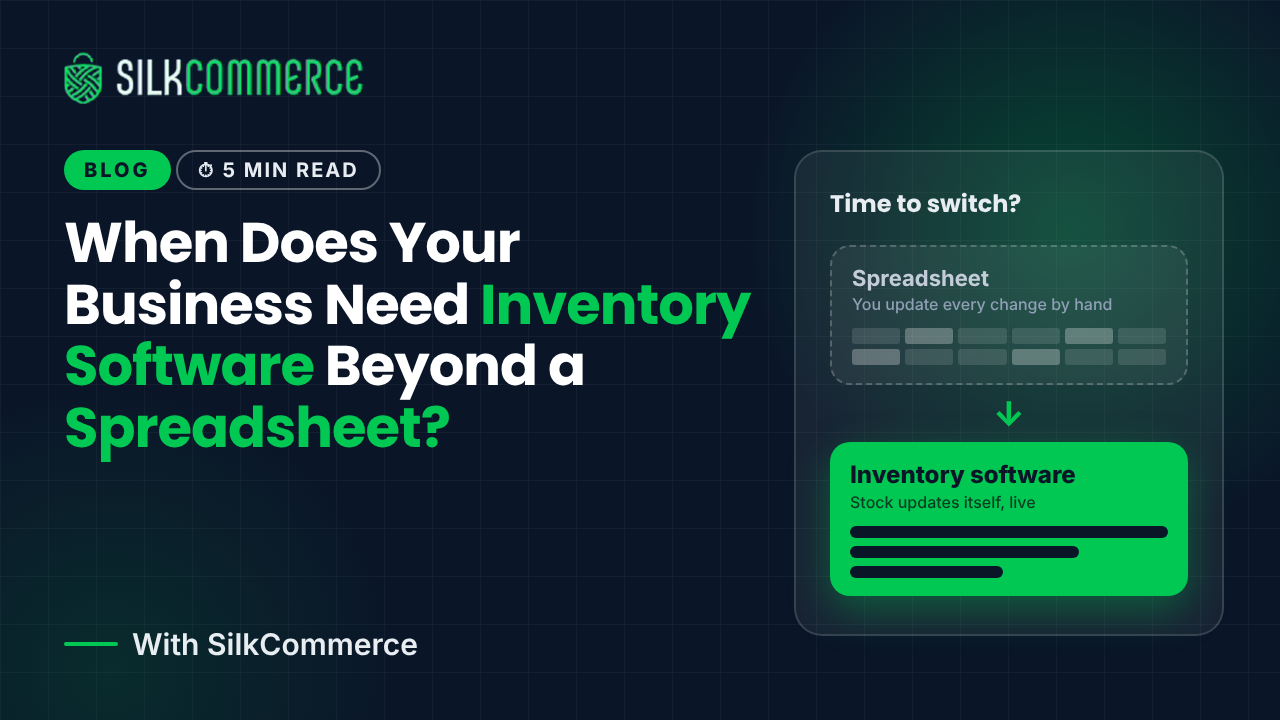
Every online business starts the same way: a notebook, a WhatsApp status, or a simple spreadsheet. And honestly, that is fine. A spreadsheet is free, familiar and good enough when you are selling a few items a day.
But there comes a point when the spreadsheet stops helping you and starts slowing you down. The tricky part is that this point does not announce itself. You only notice when a customer pays for something you no longer have, or when you spend your Sunday updating numbers instead of resting.
So how do you know it is time to move on? Here is a simple guide.
First, spreadsheets are not the enemy
If you sell from one place, have a small number of products and are the only person updating stock, a spreadsheet can work well. It costs nothing and you control everything.
The problem is not the spreadsheet itself. The problem is that a spreadsheet only knows what you type into it. It does not know when someone buys something, when a payment arrives or when stock is running low. You have to do all of that by hand, and as your business grows, "by hand" becomes expensive in time and mistakes

7 signs your spreadsheet is holding you back
1. Two people edit it, and the numbers do not match
One person updates stock in the morning, another in the afternoon, and nobody is sure which version is correct. Once more than one person touches the sheet, mistakes are almost guaranteed.
2. You sell in more than one place
You post on Instagram, take orders on WhatsApp and also have a website. Each time something sells, you have to update every place yourself. Miss one, and a customer buys something that is already gone.
3. You spend hours updating stock instead of selling
If your week includes a regular "stock update session," that is time you could spend finding customers, restocking or replying to messages
4. Customers order items that are already sold out
Nothing hurts trust like saying "sorry, that is finished" after a customer has already paid. If this happens more than once in a while, your stock records are not keeping up.
5. You cannot quickly tell what sells best
Which product made you the most money last month? Which one has been sitting on the shelf for weeks? With a spreadsheet, you can find out, but it takes time to build the formulas and read through the rows. Most busy sellers never get round to it.
6. You have more than one shop or storage place Stock in a shop in Westlands, more at home and some with a supplier? Tracking each location in a spreadsheet gets messy fast.
7. Payments and stock live in different places
You receive an M-Pesa payment, then you separately remember to reduce your stock. That gap is where mistakes and missing records happen.
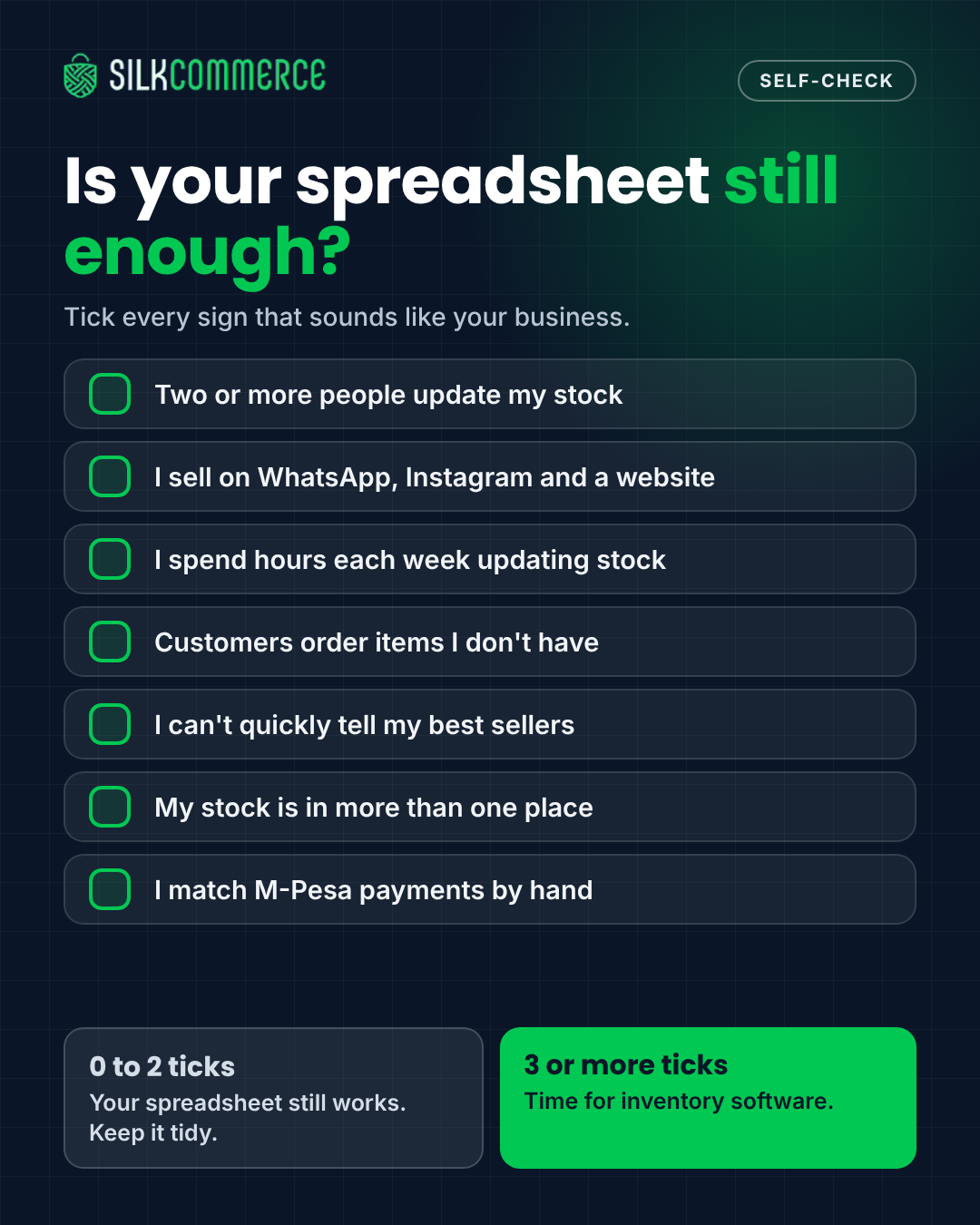
A quick self-check
Tick each sign that sounds like your business: • Two or more people update my stock • I sell on more than one platform • I spend hours each week updating stock • Customers have ordered items I did not have • I cannot tell my best-selling products quickly • I keep stock in more than one place • I match M-Pesa payments to orders by hand Ticked 0 to 2? Your spreadsheet is probably still doing the job. Keep it tidy.
Ticked 3 or more? It is time to look at proper inventory software
What changes when you switch Good inventory software does not just store numbers. It does the repetitive work for you:
• Stock updates itself. When a customer buys, the count goes down automatically. • You get warnings early. You set a low-stock level, and you are alerted before you run out. • You see what sells. Your best and slowest products are easy to spot, so you can restock smartly. • Everyone works from one source. Your team and your store see the same numbers.
How SilkCommerce helps SilkCommerce is built for Kenyan sellers. It gives you an online store with:
• M-Pesa integration, so payments and orders connect. • Inventory management, with stock counts for each product and size, and low-stock alerts. • Analytics, so you can see what is selling and what is not. • A simple store link that you can share on WhatsApp, Instagram and TikTok, with live prices and stock.
You do not have to give up the spreadsheet on day one. Many sellers start by moving their top products across, then add the rest as they get comfortable.
See how SilkCommerce can take stock updates off your hands. Start your free 14-day trial today.